
How do we expect to meet God? Where do we expect to find him? What response do we expect to have when we are finally in his presence? We hear from the prophet that God does not always show up in the manner we might expect. He often shows up when we least expect it and manifests himself in a manner inconsistent with the way those in possession of worldly power show up. The prophet reminds us that to really encounter God often requires us to remain silent, quiet and with a sensitivity to the smallest things.
Paul reminds us of the value of our life in Christ. But even more, he reminds us of the importance of our life in Christ not for ourselves but for those around us. Those who God is inviting to join him but uses us to lead them to God. Paul would gladly have allowed himself to be cut off from God for the sake of those he has preached to. This is much as a parent would gladly sacrifice themselves for the sake of their children. What are we willing to sacrifice for the sake of our neighbors? What difficulties are we willing to endure for the sake of others coming to know Jesus and obtaining the glory of heaven?
We often use Jesus’s comment to Peter, “O you of little faith, why did you doubt?” when we talk to others. Paul’s letter ties in well with Matthew’s Gospel in that when Jesus calls us, are we ready and willing to leave behind our comfort zones in the boat to walk upon the rough seas around us? What fears keep us in the boat like the other eleven? How often do we discourage those willing to leave the boat when we ourselves are not about to move an inch?
Author: yuengerwv
Retired Catholic Priest
Feast of the Transfiguration of the Lord
The first reading presents us with a vision set in heaven. We see the “Ancient One” (God the Father) and “One like a Son of man” (Jesus). It states that the son is given kingship and authority over all creation, which is echoed in the following Psalm.
Artists have for years utilized the imagery from this reading in their works. How many of us picture God with white hair, and often a full beard. How do we picture God?
In the second reading, Peter echoes the first reading and the Psalm. He also recalls his own experience on the top of the mountain with the transfiguration of Jesus. I have often had people say they wish they could hear God’s voice, then the apostles did they fell to the ground in fear! I would suspect if I heard God’s voice I would be equally filled with fear. How about you? Are we willing to accept Peter’s experience without wanting to experience it ourselves?
In the Gospel we have Jesus taking three of the many disciples with him. Do we get jealous when we were not picked for special assignments? They saw Jesus transfigured and saw Moses and Elijah. How unique it must have been for the three. Interestingly Jesus told them not to tell anyone about their experience? Ever wonder why? I speculate, jealousy, disbelief, others thinking they were delusional. I have met with many people who claim unique experiences of the divine. While it is impossible for me to verify their experiences, does that mean it didn’t happen? How do we approach others who claim experiences of God?
Maybe after the disciples experienced Jesus themselves after the resurrection they were more inclined to accept the story of Peter, James, and John. How about us? We say we believe in the resurrection of Jesus, are we delusional? Do we live our lives differently having believed that Jesus rose from the dead? Are we willing to be called crazy by todays world because we accept what others find impossible to believe?
Cycle A Fifteenth Sunday in Ordinary Time
Isiah reminds us that God’s words goes forth from his mouth; and does not return to him void but shall achieve the end for which He sent it. The Psalm reminds us that the “seed that falls on good ground will yield a fruitful harvest.” God invites us to participate with him in the process of making his word fruitful. We do this by how we respond to God and how we share in his process of seeing that a rich harvest ensues. Sometimes doing God’s will means we may need to suffer to accomplish the good that God has in mind. When this happens, do we complain? Paul invites us to consider that the sufferings of this present time areas nothing, compared with the glory to be revealed for us.
Jesus builds on this theme when he speaks of the Sower and the realities of the ministry, we are called to participate in. How many of us are concerned about the success of our works? Remember in the parable only ¼ of the seeds actually grow to maturity. If a college coach wins only ¼ of their ball games how long would he be kept as coach? Yet with Jesus, the issue isn’t how many grow, it is about the fruit of the few that do grow. We need to remember that life isn’t about the quantity but the quality.
Cycle A Fourteenth Sunday in Ordinary Time
Historically kings placed burdens on the people: taxes, land grabs, forced to fight battles, forced labor on the king’s property, forced to give their daughters and sons into the king’s service. The first reading pictures a different kind a king. A king who is humble and meek. A king who is not about making war and increasing his wealth but who banishes war and forcing the people to fight his battles.
Paul reminds us that we are called to go beyond the world’s expectations of behavior, just as the king in the first reading goes beyond the normal kings of the world. We are called to live by the Spirit of God rather than the flesh of men.
Jesus tells his disciples, “Take my yoke upon you and learn from me, for I am meek and humble of heart; and you will find rest for yourselves. For my yoke is easy, and my burden light.” Anyone who as seen a real yoke knows they are heavy and designed for beasts of burden who are forced to work hard to plow and do other shores. Jesus, like the king in the first reading, is a meek king who is concerned about his people. He lightens their load rather than increases it. Do we follow his example of helping people out of generosity and strive to make their loads easier?
Cycle A Thirteenth Sunday in Ordinary Time
Cycle A Thirteenth Sunday in Ordinary Time
In the first reading we hear of the prophet Elisha who had been treated graciously asking God to reward his hosts for their generosity. Many times, while growing up children are instructed by their parents to say, “Thank You.” No doubt when her child was born, she would have said as we do in the Psalm today, “I will sing the goodness of the Lord.” The woman who welcomed the prophet did so out of genuine hospitality, not because she would get something in return.
I knew a man who volunteered for United Way only because his boss did, and he saw it as a way to get a promotion. How often do we do something only because we will get a benefit.
In today’s Gospel Jesus reminds us that we need to be doing good things but also that we need to be doing the good for the right reason. Doing something for the wrong reason cheapens our actions and makes us less rather than greater. When Jesus talks about the fruit that his disciples will bear, he also says to make sure the fruit is good fruit and not rotten fruit. Many vines may produce berries, but not all make a good wine.
Cycle A Twelfth Sunday in Ordinary Time
Jeremiah speaks of the fact that he was unpopular for speaking words people didn’t want to hear. How often are we looked down upon by others for proclaiming the truth God has spoken to us? Why are we surprised when such happens? The world does not want to hear what God has to say. Yet, despite the difficulties, God will prevail. We need to be faithful even when all seems lost. Like Jeremiah, we need to persevere in proclaiming God’s word even when the world is against us and doesn’t want to hear the truth. The psalmist reminds us that such is not a new response. He states, “For your sake I bear insult, and shame covers my face. I have become an outcast to my brothers, a stranger to my children, because zeal for your house consumes me, and the insults of those who blaspheme you fall upon me.” Why should we expect anything less as disciples of Jesus?
The Gospel reminds us that despite our mistreatment we should fear no one. We are called to, “Not be afraid of those who kill the body but cannot kill the soul; rather, be afraid of the one who can destroy both soul and body in Gehenna.” In a world where we are called to deny our faith, to deny the teachings of the Church, to denounce the pope and what he stands for, Jesus reminds us, “Everyone who acknowledges me before others I will acknowledge before my heavenly Father. But whoever denies me before others, I will deny before my heavenly Father.” When we die and are judged by Jesus will he acknowledge us or deny us?
Additional Thoughts: I remember a story of the Franciscan Brother Juniper. He rejoiced when he was treated poorly and saw it as a way of joining himself closer to Jesus. When the apostles were mistreated, they too rejoiced when they were found worthy of suffering for Jesus, and the sake of the Gospel. Are we willing to accept mistreatment for the sake of our faith and our following the teachings of the Church?
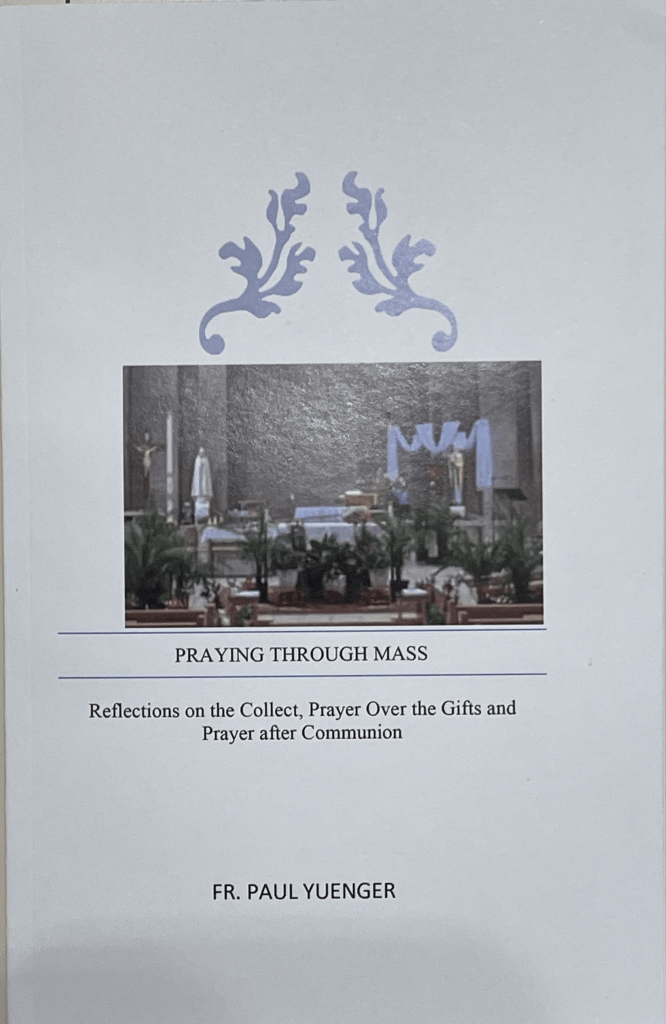
New Book: Praying Through the Mass
I have recently self-published a book “Praying Through the Mass” that some of you may be interested in.
It is a book of reflections on the Collect, Prayer over the Gifts, Prayer after Communion, and when present, a prayer with the final blessing throughout the liturgical year.
These prayers from the Roman Missal are read at every mass, though most people have paid scant attention to them as they are recited only by the presiding priest.
I have found the theology expressed to be profound and needed to be looked at more carefully. If you are interested in obtaining a copy you can send me an e-mail and I will be happy to provide you with a copy. There is no fee for the book, however, I will ask for a donation to cover the printing and shipping costs.
Peace and Love
Fr. Paul
Cycle A Eleventh Sunday in Ordinary Time
Remember from school something called Boolean Logic? Most often it is seen these days in computer programs, but also is used often enough by some manipulative people to get their way. It is recognized by the “IF, THEN” that is used. The first reading has such being used by God, in a positive way to motivate the Israelites he just rescued from Egypt. If we harken to his voice, (the then is unspoken) he will bless us and make us dearer than all other people. How are we doing? Or are we trying to be in charge of the logic by telling God, if he does as we request, then…
The Gospel shows Jesus having the same pity for the crowds that God had with the Israelites in Egypt. He calls them sheep without a shepherd. Jesus selects twelve to be apostles and gives them the authority over unclean spirits and to cure diseases. Do we stop to think that even Judas Iscariot is among those twelve? Jesus personally called Judas, as he did the others. He gave him the same authority he gave the others. He treated him with the same love and compassion he treated everyone. Often people complain about our priests and bishops. One-twelfth of those personally picked by Jesus was rotten. Regardless of other personal issues, they, as Judas and the eleven-twelfth, are given the same authority.
Perhaps as we continue forward, during “ordinary time” we can pray for our priests and bishops, asking God to touch their hearts and give us the grace we need to listen to the truth, regardless of the qualities of the messengers.
Additional thoughts. Jesus asks the disciples to pray for workers for the harvest. We forget that the greater number of workers are the lay persons, not the bishops and priest or religious. In Ordinary Time we should remember it is Ordinary People who are the primary harvesters. Those who interact with the world on a daily basis are the primary means of evangelization. How we live each day and interact with others at work, in social areas, etc. are the primary witness of what our faith means to us. Bishops and priests can provide the sacraments and support we need, but it is not the bishops or priests that have the greatest impact. This is even more important in a world that doesn’t want to hear from priests and bishops whom they say are “out of touch with reality”.
Cycle A Pentecost Sunday
Happy Birthday to the Church. Pentecost is traditionally seen as the birthday of the Church with the descent of the Holy Spirit empowering the disciples to move forward toward the future instead of focusing on the past. In their own language, they heard the apostles speaking of the “mighty acts of God.” The focus on the Spirt and the transformation that occurs when we allow the Holy Spirit to move in us and others is emphasized in the psalm response, “Lord, send out your Spirit, and renew the face of the earth.” Yet as humans how quick are we to want God to renew the face of the earth? Are we content with the way things are? Are we willing to undergo the changes necessary for the earth to be renewed?
Paul points out that the renewal can take various forms, not all identical. So often we expect everything to be “the same”. Some people in the Church complain when someone does something different from whatever tradition they are hanging on to. He reminds us that we are one body even when we don’t look, sound, or act alike. The spirit moves as it chooses within each person and community.
The Gospel reminds us that the coming of the Spirit was clearly intended by Jesus. It is also emphasized that the forgiveness of sins was such an important part of Jesus’ ministry that he instructed the disciples to make sure such continues in their ministry. How quick are we to forgive others the sins they have committed?
Cycle A The Ascension of the Lord
While in many locations the Ascension of the Lord takes place exactly forty days after Easter on a Thursday, in our diocese it has been transferred to the following Sunday. Regardless of when we celebrate it Luke and Matthew’s readings reminds us that while Jesus assisted the disciples for a period of time after his resurrection, like all disciples, they had to strike out on their own sooner or later. They tell the story of the disciples gathering on a mountain as Jesus ascends. Even at this later time, some disciples still didn’t get the whole picture and expected Jesus to establish an earthly kingdom. How often do we listen to what God and the Church tell us and not “get it”?
Like the disciples, we have been given a mission by virtue of our baptism. How often would someone ask us, “why are you standing there looking at the sky?” Our job is to, “Go, therefore, and make disciples of all nations.” And to, “teach them to observe all that I have commanded you.” How can we teach unless we ourselves have learned? Perhaps as we move forward to Pentecost and Ordinary Times, we can resolve to do a better job learning our faith so that, as we heard in 1st Peter last week, we are “Always be ready to give an explanation to anyone who asks you for a reason for your hope.” When we feel ill equipped, we need to remember, Jesus is “with you always, until the end of the age.”
 Countenance of God